There is a version of collecting that looks, from the outside, like investing. Works are acquired quickly, held briefly, and rotated when the market moves. It is not without logic, and it is not without precedent. But it is not, in any meaningful sense, collecting.
The distinction matters, and not only as a moral judgement. Collections built slowly, by people with a developing eye and real conviction about the works, tend to outperform in every dimension that counts. That includes the financial and the reputational, but also the quieter satisfaction of having assembled something coherent.
The flipped work rarely remembers you. The work you lived with for decades often defines you.
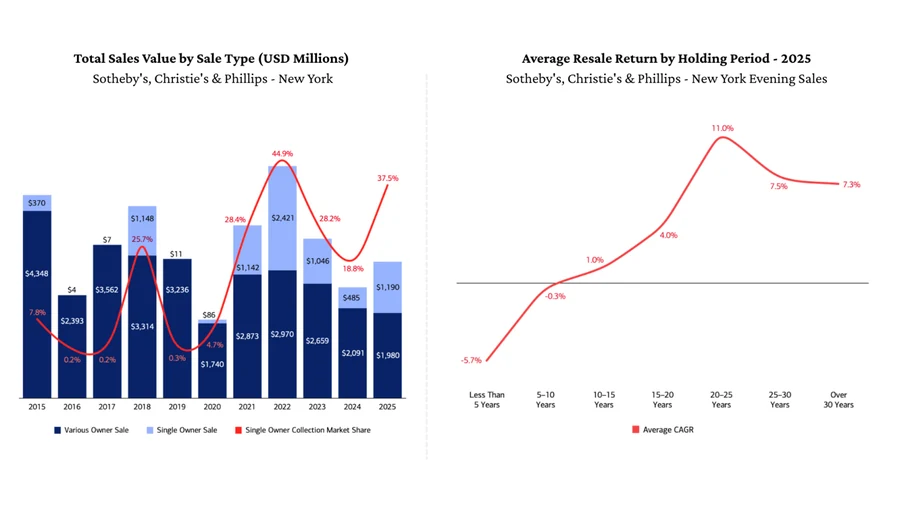
Consider the evidence auction houses would rather you didn't dwell on. The sales that genuinely move the market, the ones that define a season or rescue a year's totals, are almost always single-owner collections. They are collections that took decades to build, and minutes to explain why they matter.
The numbers are unambiguous, and the research confirms what the market has long suggested. According to the Bank of America and ArtTactic US Art Market Report 2026, works resold within five years of acquisition posted an average annualised return of -5.7% in 2025 - a sharp reversal from the 16.6% those same short-term trades produced during the post-pandemic surge of 2021. Works held for five to ten years effectively broke even. But lots returning to auction after more than a decade delivered positive returns, and works held between twenty and twenty-five years averaged 11.0% CAGR. The same report found that single-owner collections now account for 37.5% of New York auction value - up from an average of just 6.5% between 2015 and 2020 - with prices achieved at 1.53 times the mid-estimate, compared to 1.00 for the broader market. Patience, it turns out, is not merely a disposition.
It's worth understanding why the numbers behave this way, because the pattern isn't really about taste or timing. The arithmetic of frequent trading at auction is unforgiving. A work sold at a major house typically carries a buyer's premium in the region of 26%, a seller's commission negotiated down from a comparable figure, and the running costs of insurance, storage, shipping and restoration. In many jurisdictions there is capital gains tax on top. Before any question of appreciation arises, a work has to rise materially in value just to break even. The -5.7% return on sub-five-year resales is therefore less surprising than it first sounds: the market does not have to fall for the flipper to lose. It only has to fail to rise fast enough to clear those costs. Dealers make this arithmetic work through volume, turnover and privileged information. Collectors acting on market sentiment almost never can. Patience, viewed this way, is partly the simple matter of reducing friction over a longer hold.
The dealer exception deserves acknowledgement. Families like the Mugrabis or Nahmads, who hold deep inventory in a handful of artists, can trade against their own supply in ways an individual collector cannot: they know what is coming to market, they can support prices where it serves them, and their hold periods are measured by strategy rather than sentiment. But this is a professional position built on volume, information, and the ability to absorb a bad season. It is not a model available to most collectors, and attempts to imitate it from the outside are what produce the -5.7% figure in the first place.
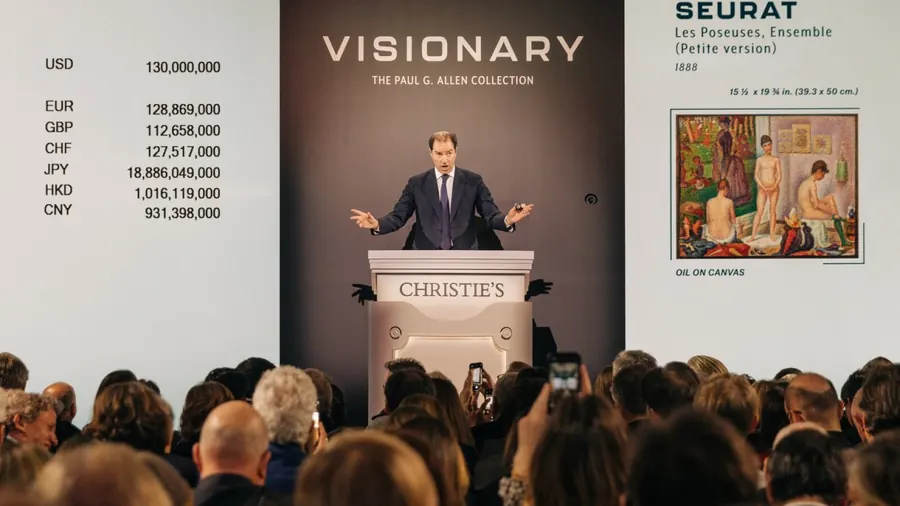
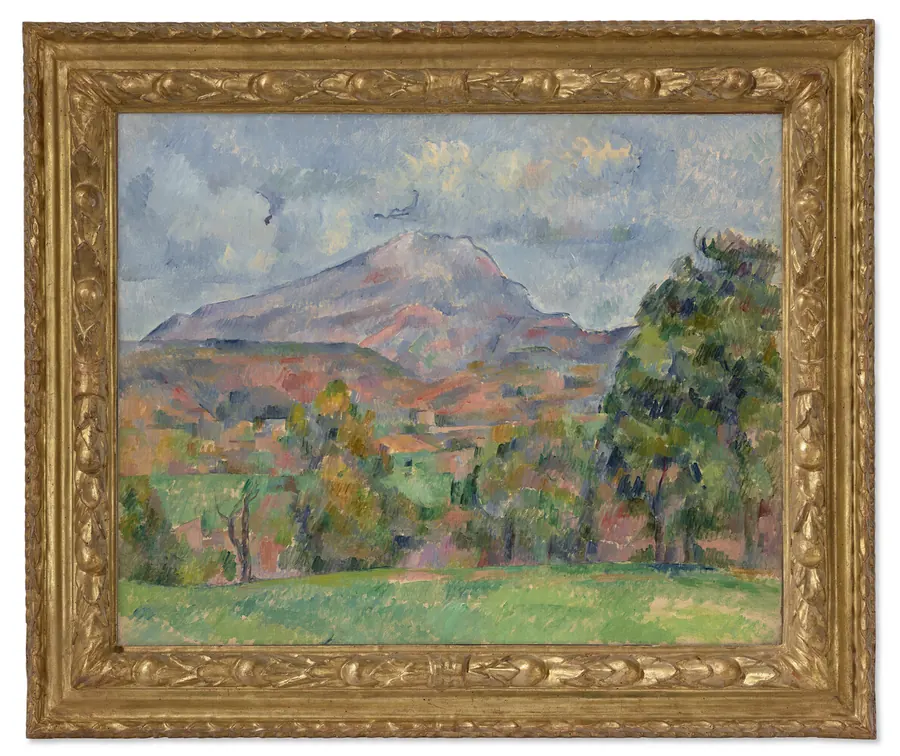
When Christie's sold the Paul Allen estate across two days in November 2022, sixty works realised $1.5 billion in a single evening, the highest total ever achieved at auction and $1.62 billion in aggregate. That one collection accounted for roughly a fifth of Christie's record $8.4 billion global total for the year. Five works sold above $100 million. The result didn't happen because Allen bought fast and sold faster. It happened because he bought with conviction, held for decades, and assembled something with an identifiable point of view. His Cézanne, La Montagne Sainte-Victoire (1888-90) acquired in 2001 for $38.5 million, sold that evening for $137.8 million. Time did most of the work. It is worth noting, however, that the Allen result was partly a masterpiece of financial engineering: every one of the 60 lots was backed by financial guarantees, with third-party backers pre-buying 33 lots totalling nearly $1 billion before the first hammer fell. Patient collections attract patient capital, but the "record-setting" headline numbers are often structurally pre-arranged.
Before Allen, the record had belonged to the Rockefellers. When Christie's offered the Peggy and David Rockefeller collection in May 2018, it realised $832 million, accounting for more than three-quarters of Christie's 35% first-half sales increase that year. One New York adviser noted that bidders paid 30% or more above estimate simply for the provenance. The name was worth that much, not because of celebrity, but because of the quality and consistency that decades of serious collecting had produced. The market continues to validate this long-hold strategy. Anne Bass's estate realised $363 million at Christie's in May 2022 from just twelve works, and the Si Newhouse estate, which Christie's began selling in 2019, continues to sustain similar results, confirming that the 'quality and consistency' premium applies regardless of the specific collector's gender or niche, provided the holding period is measured in decades.
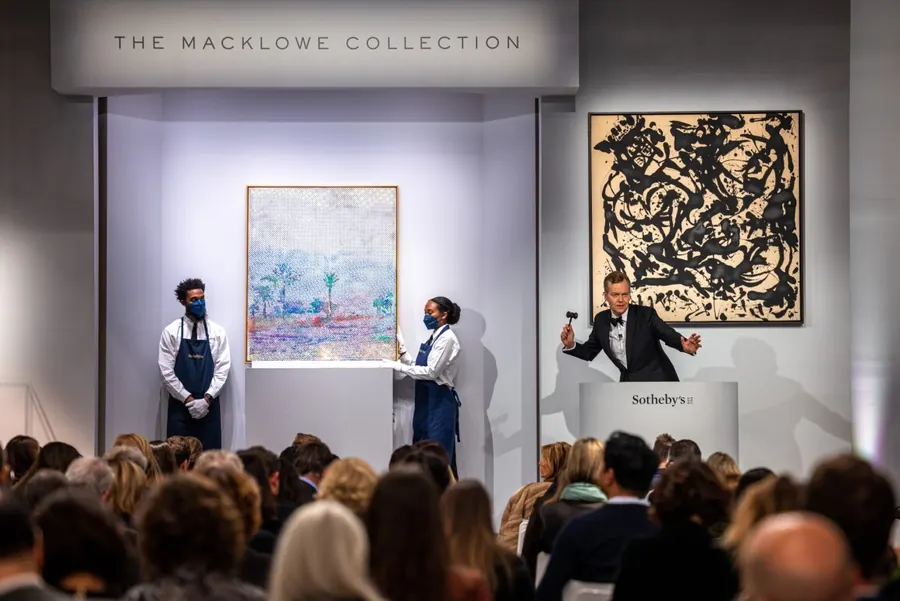
The Macklowe collection, sold in two tranches at Sotheby's following a court-ordered divorce sale, generated $922 million. Even a collection broken up under duress, assembled by people who could not agree on much at the end, commanded nearly a billion dollars. Emily Fisher Landau, whose holdings sold at Sotheby's in 2023 for $424.7 million, the most valuable sale ever devoted to a female collector, had spent decades acquiring works directly from artists and their galleries, building relationships as much as a collection. That long view was inseparable from the result.
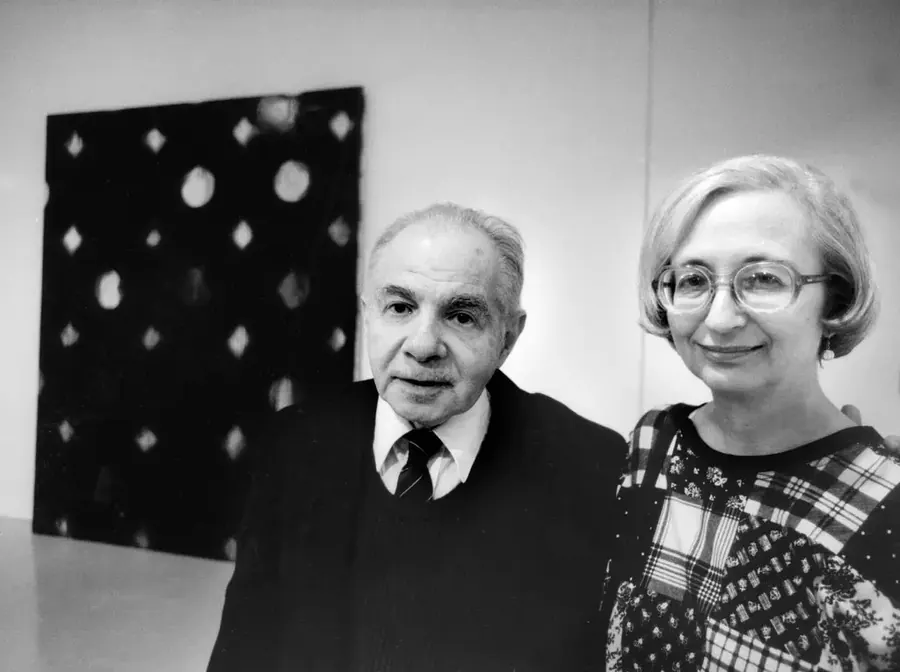
It would be easy to read these totals and conclude the thesis belongs only to the very wealthy. It doesn't. Victor and Sally Ganz bought their first Picasso in 1941 for $7,000. He was a costume jewellery manufacturer; she was a teacher. Over the following five decades they acquired deeply rather than widely: Picasso, then Johns, Rauschenberg, Stella and Eva Hesse buying what they understood rather than what was fashionable at the moment. When the collection was sold at Christie's in 1997, after both had died, it realised $206.5 million, at the time the most valuable private collection ever offered at auction. The Ganzes were consistently outspent by the collectors they competed with. What they had instead was conviction, and the willingness to live with works others hadn't yet recognised. Herb and Dorothy Vogel, more modest still (he a postal worker, she a librarian), assembled some four thousand works of minimalist and conceptual art, much of it bought directly from artists before those artists had critical recognition. The Vogels eventually gave most of the collection to the National Gallery of Art rather than sell it, which perhaps makes the point more cleanly than any auction could: what they had assembled was of museum quality, accumulated on a civil servant's salary, because they spent forty years paying attention.
There is also a supply-side reason patience pays, and it may be the least discussed force in the market. The works that come to matter tend to leave circulation permanently. They enter museum collections, often as gifts or bequests from patient collectors themselves, and the pool of available significant examples by any given artist narrows with time. The flipper sells into a market where comparable works are still abundant. The patient holder, when they or their estate eventually sells, sells into one where those comparables have been thinned by a generation of gifts, donations and long holds. Look at any major artist's auction record and the highest prices cluster around works with long private provenance, precisely because the shorter-held works have, at each transaction, set a ceiling that the scarcer older examples then quietly step over.
This scarcity compounds for institutional reasons that transcend simple collector behaviour. Museum deaccessioning rules are notoriously rigid; once a work enters a major public collection, it is effectively off market forever. Every significant Cézanne, Picasso, or Rothko that enters the Met, MoMA, or Tate tightens the global supply of available masterpieces. The Vogels' donation to the National Gallery, the Whitney gifts that grew out of Emily Fisher Landau's collection, the Rockefeller MoMA bequests, or Rauschenberg's estate to the Rauschenberg Foundation: each of these removes a generation of material from circulation in a single stroke. The patient holder is not only competing with fewer comparables at resale. They are competing with a supply curve that has been quietly bent upward by every previous patient holder who chose to give rather than sell.
These are not outliers. When a collection of genuine depth comes to auction, it does so as an argument, for an artist, for a period, for a way of seeing, and the room responds in kind. The haste-driven accumulation rarely produces this. The estate sale of someone who bought carefully, slowly, and with sustained curiosity almost always does.
None of this is to say that every short hold is a mistake, or that active trading has no legitimate place in the market. Dealers, by definition, hold briefly. Some professional market-makers succeed with a strategic, inventory-heavy approach, maintaining depth in specific artists and leveraging information advantages to navigate shorter cycles effectively. But this is market-making, not collecting. Some artists have markets that reward tactical positioning. Plenty of genuine collectors build coherent holdings while rotating some works around the edges. The criticism isn't of selling, and it isn't of strategy. It's of a particular posture: treating works as instruments of a market view rather than as objects of sustained attention.
The current market makes patience harder to sustain. Uncertainty encourages action. When values feel volatile and tastes seem to be shifting, the instinct is to move, to sell before the dip deepens, to rotate into whatever category looks ascendant. That instinct is understandable. But anyone who has watched enough collectors navigate enough cycles knows that those who act on it consistently tend to regret it. The recent vogue for ultra-contemporary flipping has since produced a long list of works that now change hands for a fraction of their auction peak, which should surprise no one who understood what was being traded.
Patience is also a discipline of acquisition, not just retention. Some of the finest collections were built by people who waited, sometimes years, for the right work by an artist they believed in, rather than settling for what was immediately available. That gap between an artist's critical recognition and their full market recognition is one of the most consistent opportunities in the art world. It closes slowly, and rewards those who arrived early and stayed. It's also the period in which relationships form. Galleries representing serious artists allocate by conviction as much as by capital, and those allocations compound. Collectors who hold tend to move up waiting lists. Collectors who flip tend to move down them, or off them entirely. Access is a second-order return on patience, and it's often worth more than the first.
In practice, patience is cultivated by structure more than by temperament. The collectors who hold well tend to budget for the full cost of ownership, including storage, insurance, and the capital locked up in the works themselves, so that nothing ever has to be sold under pressure. They review their collections on their own calendar, not the market's. And they are disciplined about the difference between considering a sale and reacting to one: the first is editing, the second is flinching - the two can look deceptively similar.
None of this means every work should be held indefinitely, or that collecting strategy has no place in a thoughtful practice. There are good reasons to sell, to fund an acquisition of greater significance, to edit a collection that has grown beyond its own logic, or simply because the relationship with a work has run its course. The collectors who make those decisions well are the same ones who acquired deliberately in the first place. Conviction, once established, tends to be consistent. So does its absence.
The best collections are rarely the fastest. They are the ones built by people who understood that what they were assembling was larger than any single transaction, and who were prepared to wait for it to become so.
Images are reproduced for criticism and review. If you hold the rights to one and would like it credited differently or removed, please contact enquiries@klpartners.uk.