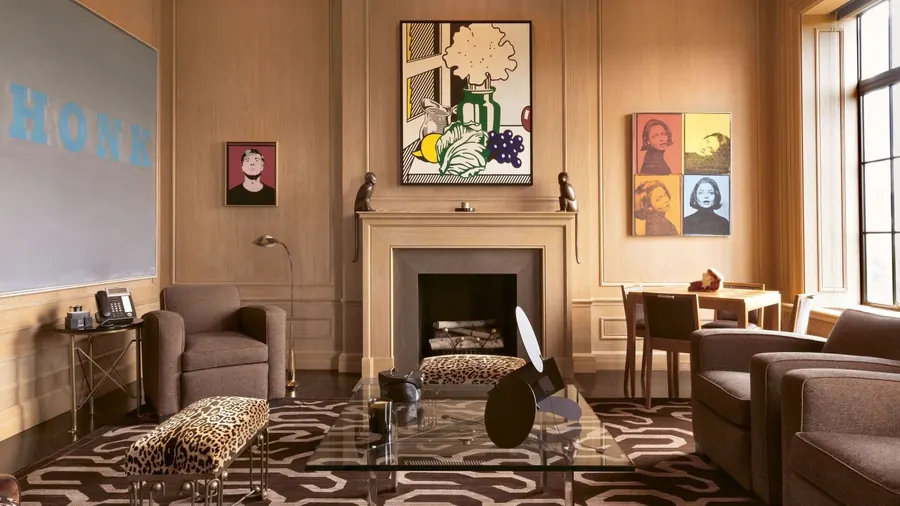
In September last year, Sotheby's gave over a large part of its New Bond Street galleries to a reconstruction. Leopard-print carpet went down. Mattia Bonetti's bookcase was reassembled. The Lalanne furniture was set out as it had stood in Pauline Karpidas's flat overlooking Hyde Park, and the Surrealists went back up in something close to their old relation to one another. Then the whole thing was sold. Across three sessions, all 345 lots found buyers for £100.9m against a high estimate of £69m, the largest single-owner result recorded in London. Two years earlier the contents of her Hydra house had made $37.6m, more than double its estimate.
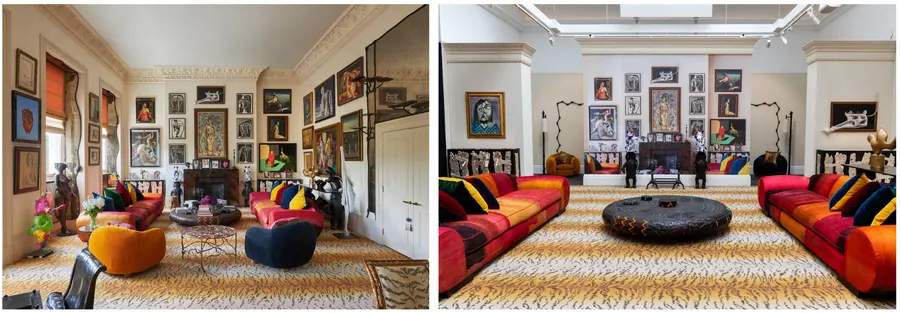
So an auction house spent money rebuilding a room in order to take it apart? Nobody involved appeared to find this strange.
They were right not to. Karpidas had spent four decades assembling an interior in which the Magrittes, the Lalanne’s, the Bonetti bookcase and the animal-print floor were all doing the same job. Much of the furniture had been made or bought for those specific rooms. An owl bed, a butterfly chandelier, mirrored window frames cut to fit particular windows. Sotheby's understood that people were bidding partly on a world, and that the world had to be visible for a fortnight before it could be dismantled and posted to two hundred addresses where none of it would ever line up again.
The trade will tell you, when it suits, that a picture is a picture and the room is just the room. Then it spends real money proving otherwise, and the proof works.
The invention of the empty wall
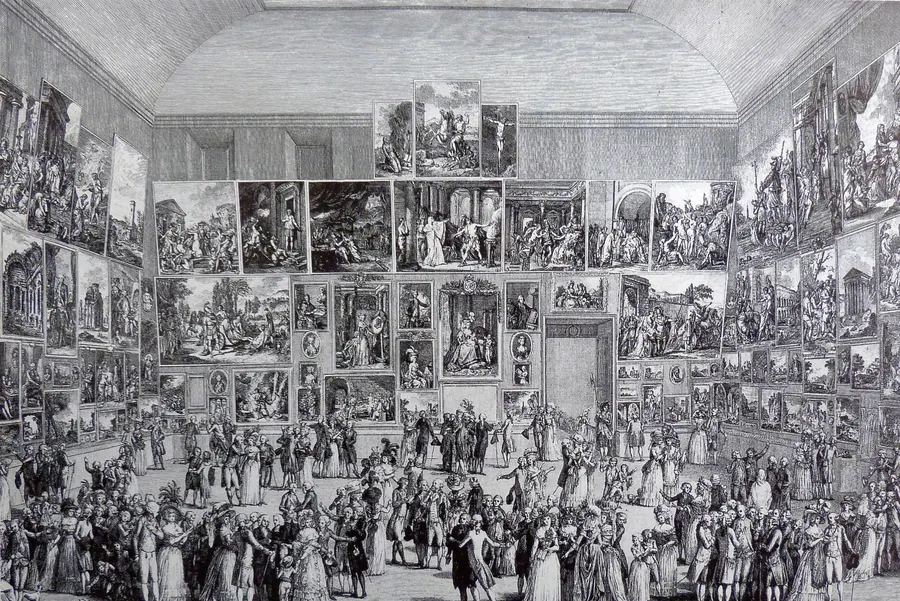
For most of the history of Western collecting nobody would have thought to argue the point, because a picture separated from its setting barely existed as an idea. Paintings hung frame-to-frame, three and four rows deep, on red or green damask, in rooms with furniture and daylight and other paintings pressing in from every side. We read the salon hang now as clutter, which is unfair to it. It was an accurate account of what a picture was then understood to be, one element in a decorated interior, competing for attention with everything else in the room.
The single line at eye level on a white wall is a twentieth-century invention. It came out of German museum reform in the 1920s, consolidated in New York under Alfred Barr, and by the 1970s had become so ordinary that it had stopped being visible as a choice at all. When Brian O'Doherty published his three essays in Artforum in the mid 70’s, later collected as Inside the White Cube, he was attacking it rather than defending it. His complaint was that the white gallery had an ideology and had learned to pretend it had none.
Part of the case for neutrality is just optical. Simultaneous contrast is measurable, and Josef Albers spent the better part of his career on it. The Homage to the Square paintings and Interaction of Color are both demonstrations that a colour has no fixed appearance, only a relationship with whatever sits next to it. The same grey reads warm against one field and cold against another. Albers was making a point about painting, but it applies with equal force one step outward. A strongly coloured wall does not merely compete with a picture. It changes the colours inside it. Consistent light does the same work from the other direction, and conservators have sound reasons for wanting a quiet surround.
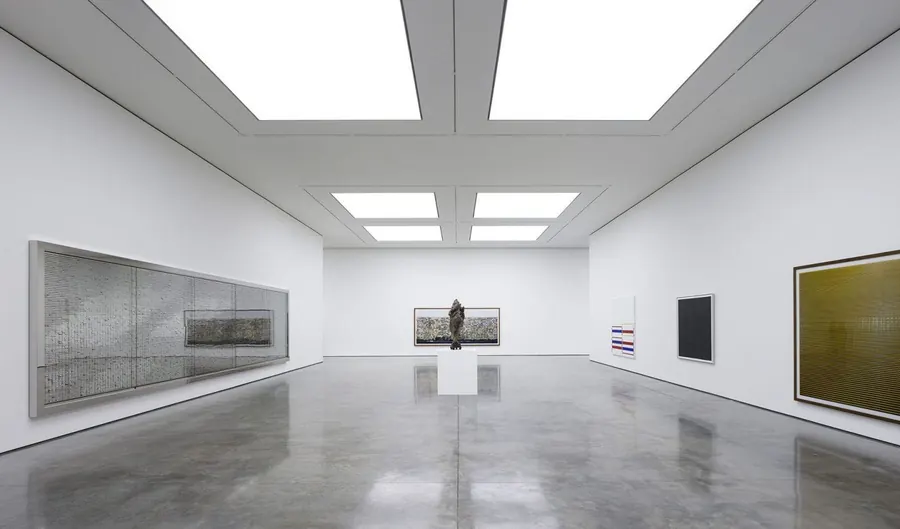
What none of that gets you to is white specifically. Serious institutions argue for warm greys and off-whites on precisely the same evidence, and the empirical research on wall colour and viewer behaviour is thin and contradictory. The white cube is a convention that hardened into an assumption, which is a more interesting thing to be than an optimum. It works. But a room that announces its own neutrality is making the largest claim available, which is that what you are looking at is above context, outside time, and not to be argued with. Commercial galleries don’t do this by accident. Jay Jopling went so far as to name his gallery "White Cube" as a self-aware and ironic embrace of O'Doherty's critique.
Where the convention gets set aside deliberately, the results can be better rather than worse. Venturi and Scott Brown built the Sainsbury Wing as something closer to a nave than a gallery. It was designed around fifteenth-century altarpieces made for exactly that sort of space, which look almost homeless anywhere else. The building was derided when it opened in 1991. It reopened in May 2025 after an £85m programme led by Selldorf Architects, and it is now hard to find anyone in London who thinks those are the wrong rooms for those pictures.
The wall had learned to look like an absence while quietly donating meaning to everything hung on it.
Why nobody builds a warehouse
If the vessel were genuinely incidental, the cheapest available shed would do. Institutions have never behaved as though they believed that, and the sums involved are not marginal.
Under the 2007 agreement between France and the UAE, Abu Dhabi paid around €400m, then around $525m, for the right to put the word Louvre above the door for thirty years and six months. A further $747m covered loans, exhibitions and advice. Jean Nouvel's building, with its 180-metre dome and 7,000 tonnes of steel, cost extra. Half a billion dollars for a name, before a single object was hung. Nobody spends that unless the word and the roof are doing work the paintings cannot do by themselves.
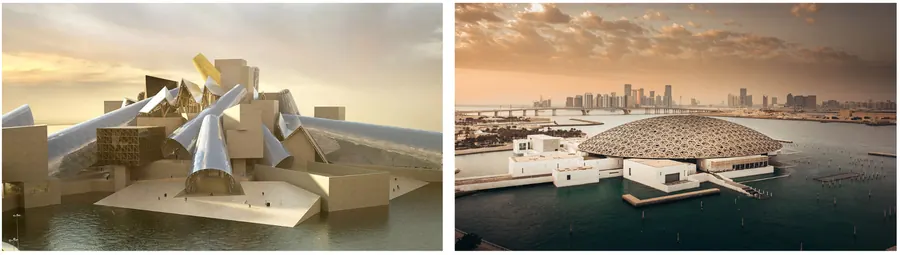
Last week, Abu Dhabi's Department of Culture and Tourism confirmed that the Guggenheim Abu Dhabi will open later this year. Frank Gehry's building on Saadiyat Island holds thirty galleries beneath nine metal cones rising to 88 metres and it will be the largest museum in the Guggenheim network. The project was announced in 2006. Ground was broken, abandoned, and broken again. Twenty years and a reported nine-figure budget, for a container. No trustee signs of on that if the building is only a roof. The National Gallery has been making a version of the same argument since 1824, in a portico on Trafalgar Square, and for much the same reason.
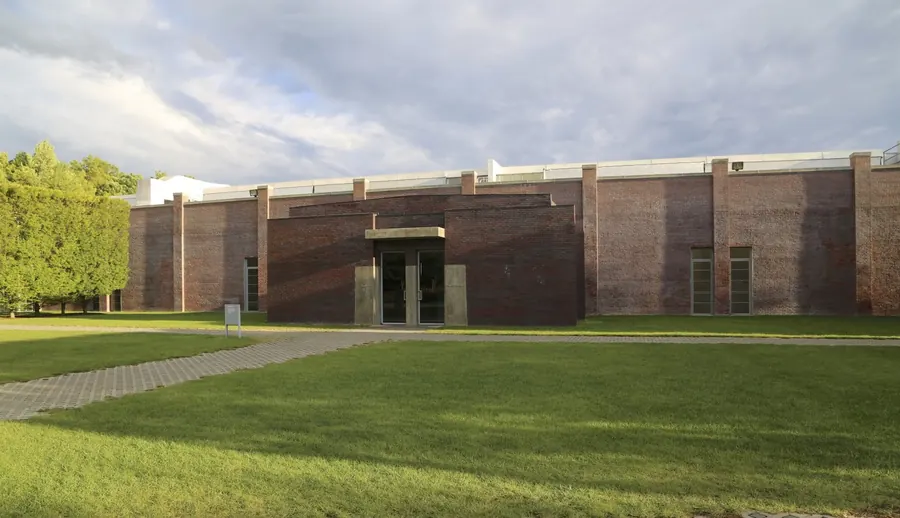
The counter-examples are also worth mentioning because they cut the argument down to the right size. Dia Beacon, a former factory on the Hudson river, opened in 2003, with sawtooth skylights and concrete floors. A great many people who look at art professionally will tell you it is the best place in the world to see Richard Serra, Donald Judd and Dan Flavin. Tate Modern is a decommissioned power station. Neither cost anything close to Bilbao. What they had instead was somebody thinking hard about the light, which is cheaper than titanium and a great deal rarer. A shed with that beats a landmark without it, and the Guggenheim's problem in Abu Dhabi may be the one Bilbao has always had, a building that photographs better than it hangs.
Living in it
The most sustained version of this thinking happens in private, over decades, and mostly without being written down.
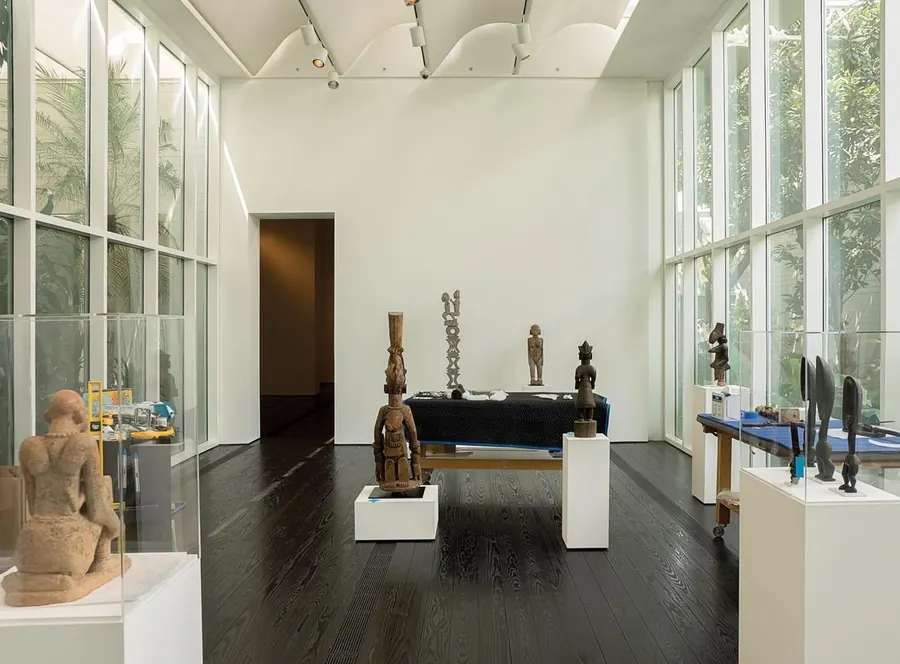
Dominique and John de Menil are the clearest case, because they did it at every scale and left the evidence standing. In 1950 they commissioned a young Philip Johnson to build them a low, flat roofed courtyard house in Houston, then handed the interiors to Charles James, who produced the only interior he is known to have designed. A Miesian frame, surrealist furniture, Magritte and African sculpture in the same rooms. In 1987, Renzo Piano's Menil Collection, a public museum whose main rooms were proportioned from the living room of the house. Fifty years of collecting produced a building whose dimensions are those of the place where the collecting happened.
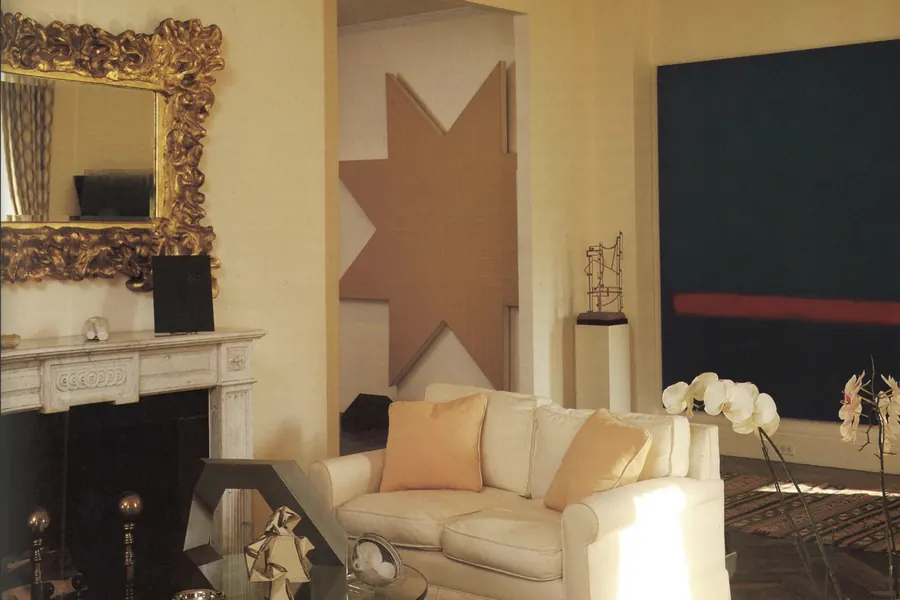
Agnes Gund did it more quietly. She bought a Rothko directly from the artist's studio in 1967, and No. 15 (Two Greens and Red Stripe) hung in her New York living room for close to sixty years, a painting that everyone who visited describes as simply part of the room. Gund died in September 2025. Last May, Christie's sold it for $98.4m, a record for the artist, inside a three-lot group that made $150.8m.
Artists never needed convincing, because for them the distinction barely holds. Dalí bought a fisherman's hut at Portlligat in 1930 and spent the next forty years buying the huts next door and joining them together without a plan, into a maze of small rooms, changed levels and dead ends. He called it “a real biological structure”, growing a new cell for each new impulse. The studio faces north for the light. The house is not the place where the work was made so much as a slower piece of the same work, and standing in it tells you things about the paintings that no catalogue will.
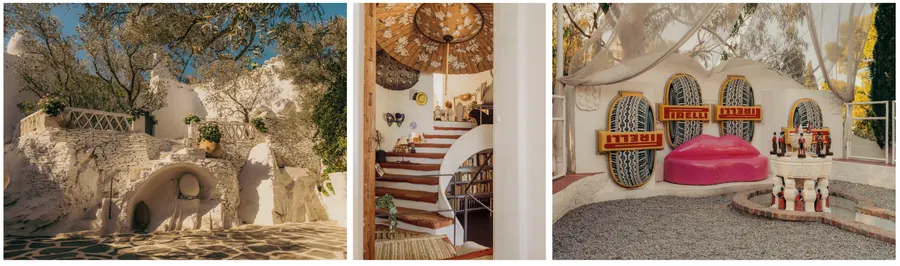
Anyone who spends time in galleries and salerooms has overheard the same sentence, in one form or another - “This would look wonderful over the fireplace” or “That would work beside the Picasso in the drawing room”. It is usually said quietly and it is the single most revealing remark made in front of a picture.
The buyer is standing in front of a work that has been deliberately stripped of context, and is putting it back with their own context, their own wall, their own light at four in the afternoon. The commercial function of the white wall is not neutrality. It is vacancy. A blank surface is far easier to sell into than a furnished room, because it lets every person who walks past install the picture at home before they have asked the price. Galleries did not arrive at this arrangement by reasoning it out. They arrived at it by finding that it worked.
The salerooms then run the process in reverse, and are quite open about it. Single-owner catalogues are dense with photography of the interiors. The picture above the sofa, the bronze on the hall table, a corner of somebody's morning. Christie's marketed the Peggy and David Rockefeller collection in 2018 under the line Live like a Rockefeller, staged the exhibition at Rockefeller Centre as a walk-through, and sold 1,500 objects for $832.6m, the highest total ever achieved for a private collection. The clearest evidence of what was actually being bought lies at the bottom of the results. A Rockefeller money clip carrying an estimate of $800 to $1,200 made $75,000. They didn’t just pay for just the gold.
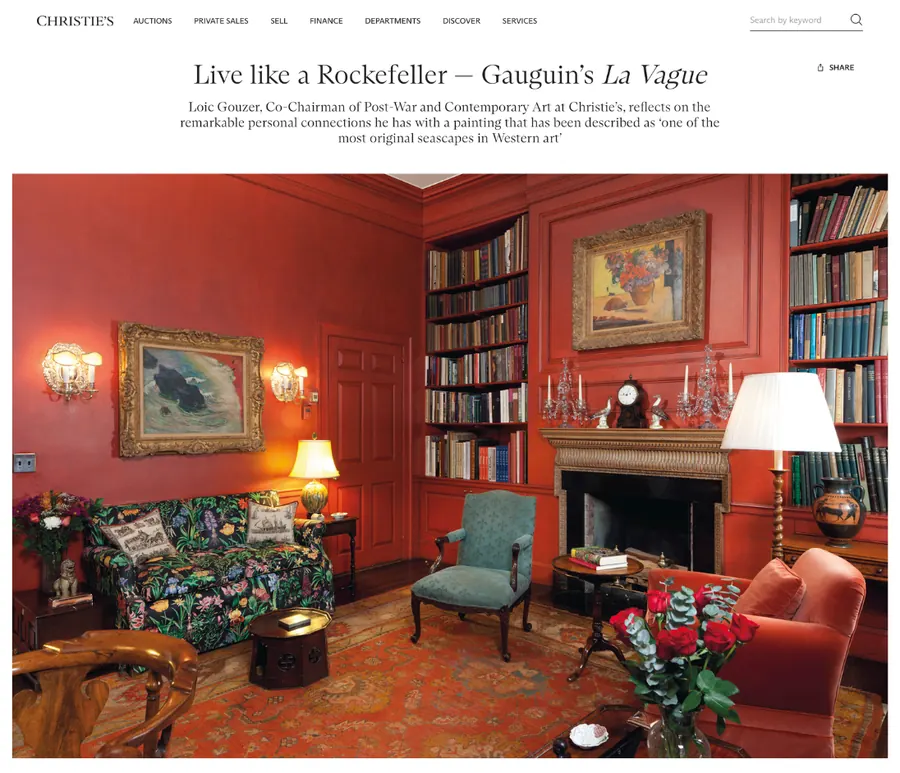
So does it genuinely matter that a work hung in Collector X's drawing room rather than sitting in a Geneva freeport under the same ownership for the same years? On the evidence, yes, and the trade has never pretended otherwise. Two quite different things are bundled inside that premium. One is a story, and stories about judgement are worth money. A photograph of the Rothko above the sofa tells a buyer that a person of known discernment looked at this every morning and did not tire of it. Buying a picture to live with is evidence of conviction. Buying it into storage is evidence of allocation. We read the first as taste and the second as a position.
The freeport picture is almost always in better condition, because darkness and stable humidity are kind to paint and domestic life is not. Sunlight through a south window, a radiator, a fire lit underneath it for thirty winters. The market pays a premium for the version that has been treated worse, and calls the damage provenance. That is not irrational, it is simply a reminder that a good deal of what is being valued was not in the object itself.
Where the two come apart
In 1958 Rothko took a commission to paint murals for the Four Seasons restaurant in Mies van der Rohe's Seagram Building. He built a scaffold in his studio to the restaurant's exact dimensions so that he could paint into the space rather than at it. Then he ate there, disliked what he saw, cancelled the contract in 1960 and returned the $35,000. Nine canvases went to the Tate in 1969 with written instructions on wall colour, hanging height and light levels.
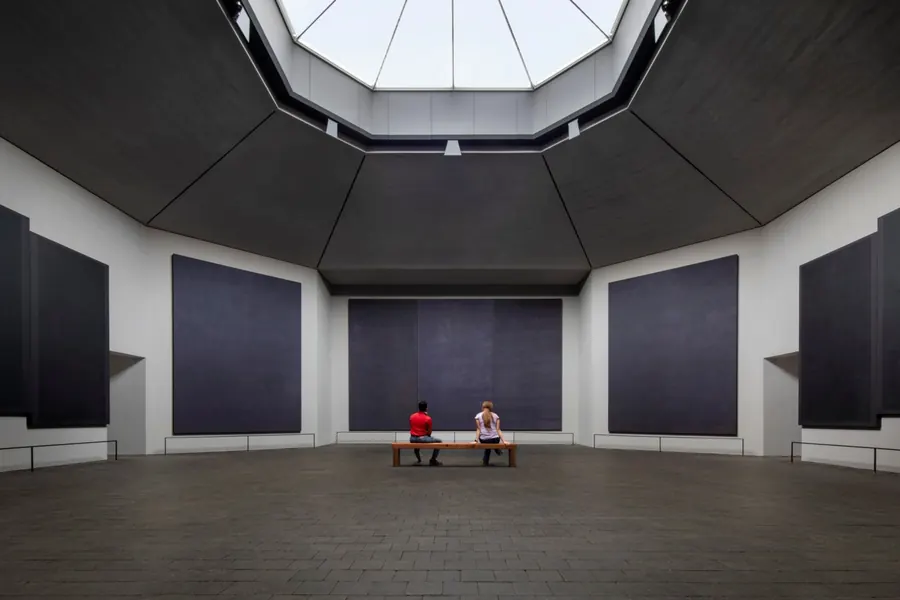
Four years after walking away from the Seagram, Rothko accepted the de Menils' commission for the chapel in Houston, and fell out with Philip Johnson again, this time over a building he thought too grand for the paintings it was meant to hold. Johnson left the project. Barnstone and Aubry finished it. Fourteen canvases in an octagonal room, opened in 1971, and by common consent one of the few places on earth where a room and the work inside it are indistinguishable. Rothko had to fight the same architect twice to get there, and didn’t live to see it.
This is not really about architects. A work conceived for a particular room becomes hostage to it, and the better the room, the tighter the hold. When Richard Serra's Tilted Arc was removed from Federal Plaza in 1989, his position was that relocation and destruction amounted to the same act, because the work was the plaza as much as it was the steel it was made from. When the Barnes Foundation moved to central Philadelphia in 2012, it reproduced the Merion arrangements wall by wall, on the reasoning that Barnes's hang was itself the thing being conserved.
This is where architecture and value stop being allies. A work made for a room is at its most articulate in that room and least portable everywhere else. The bond that produces the meaning is the same bond that makes the object hard to move, hard to lend and awkward to sell, and the market's answer to a work that cannot be moved is to pay less for it. Site-specificity enhances the experience reliably and the price hardly at all. Karpidas's owl bed did well in the saleroom. It will never again mean what it meant in the room it was built for.
Most collectors will never own a work with that problem. But every collector is making architectural decisions constantly and mostly without noticing. The height something hangs at, which door you come through and what you see first, whether the light comes from the north, what is on the wall opposite. The rooms mentioned in this piece are mostly gone. Karpidas's flat is emptied, Gund's Rothko is somewhere else now, the Seagram murals never hung where they were painted to hang. What survives is the evidence that the rooms mattered, which arrives, as it usually does, at the moment they are taken apart.
Images are reproduced for criticism and review. If you hold the rights to one and would like it credited differently or removed, please contact enquiries@klpartners.uk.