
This month in New York, the spring auctions delivered two white-glove evening sales in quick succession. On 14 May, Sotheby's sold all eleven lots from the collection of the late dealer Robert Mnuchin for $166.3m with fees - squarely within the $125–178m pre-sale estimates, and anchored by Mark Rothko's Brown and Blacks in Reds (1957) at $85.8m, the second-highest price ever paid for the artist at auction at the time of sale (another Rothko from Agnes Gund's collection reached $98.4m at Christie's on 18 May). Christie's, four days later, sold every one of the sixteen S.I. Newhouse lots for a combined $630.8m, beating its $462–595m estimates and setting new auction records for both Jackson Pollock - at $181.2m, nearly three times the artist’s previous high - and Constantin Brâncuși, at $107.5m.
Both sales were white-glove. They were not, strictly speaking, the same kind of result.

The distinction is not academic. It has become the most important variable a collector, consignor or observer can read in a sale result, and it now sits behind almost every headline figure the major houses produce. What was once a binary, sold or unsold, has become a layered question: how was the sale arranged, who carried the risk, and what was the room actually being asked to do.
A white-glove sale is no longer simply a measure of demand. It is, more often than not, a measure of how well demand has been organised in advance.
What white-glove actually means
In its narrow sense, the term describes an auction in which every lot finds a buyer. The auctioneer is presented with a pair of white gloves at the end of the sale, originally as a memento, now also as a press image. The metric itself is plain: lots offered, lots sold, percentage. A clean sweep at a major evening sale is one of the more reliable headlines an auction house can produce, and it is routinely cited as a barometer of broader market health.
Used that way, white-glove is shorthand for confidence. The shorthand is not wrong. But it has become less precise than it once was.
The symbolic weight of the term remains intact even as the underlying mechanics have shifted. Auction houses understand this very well. A white-glove result, even one largely arranged in advance, is treated by the market as evidence that confidence is returning, that consignors can be persuaded to bring material to sale, and that the next round of marquee consignments is worth competing for. That effect is real, and it is one of the reasons the language is preserved with such care, even as the conditions that originally gave it weight have changed.
A metric narrower than it appears
The first thing worth noting is that the white-glove figure refers only to lots that came under the hammer. A work withdrawn before the sale opens - for reasons ranging from a change of mind on the consignor's part to a quiet recognition that the room is unlikely to engage - does not count against the figure. Nor, in many cases, does a work withdrawn mid-sale, after specialists sense that the lot is going to fail and pull it from the proceedings before the hammer falls.
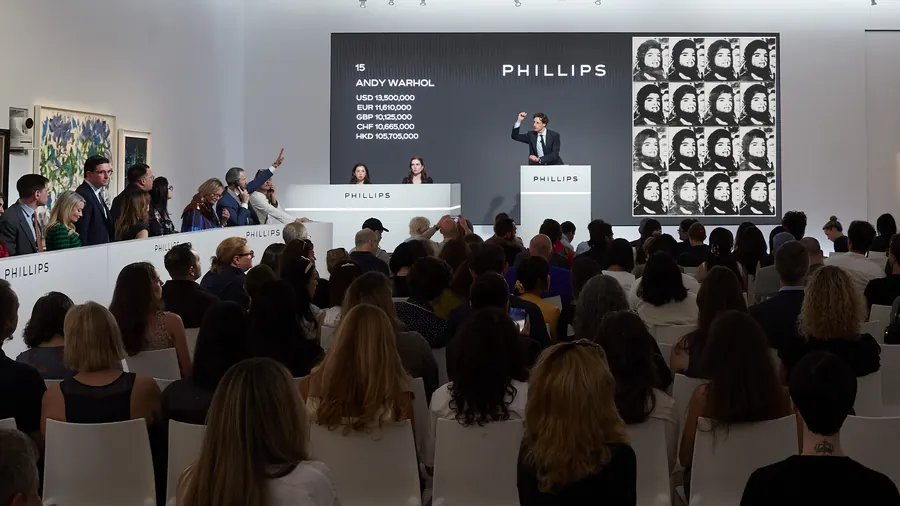
The May sales this year contained an instructive example. Phillips's Modern and Contemporary Evening Sale on 19 May was widely reported as a white-glove result, with the house selling all forty-one lots offered for $115.2m with fees. What is less often emphasised in the headlines is that the sale began with forty-three lots: a Richard Prince Nurse and a large Albert Oehlen abstraction were both withdrawn before the sale began. The "100% sold" figure was, accurately, calculated on what was offered. It was also, accurately, calculated after two of the original lots had been removed.
A second, more vivid example sat in the same room as the Mnuchin sale on 14 May. The multi-owner contemporary evening sale that directly followed Mnuchin's eleven-lot opener was reported as having a 91% sell-through rate - four lots failed to find buyers, and a 1971 Alice Neel portrait, Timothy Collins, was pulled mid-auction. The two sales ran consecutively in the same room, on the same night, with broadly the same audience. They produced two very different statistical outcomes - and only one of them was reported as a triumph.
There is nothing improper about this. Withdrawals are a normal feature of any major sale, often agreed in the final hours when a specialist senses that the room is not ready to engage at the seller's reserve, or at the consignor's request. The point is one of interpretation. A "100% sold" figure based on a forty-three lot catalogue trimmed to forty-one is not directly comparable to a "100% sold" figure on a sale where every promised lot crossed the block. Both are reported the same way but they are not the same result.
How a modern white-glove result is built
A contemporary evening sale relies on three financial instruments designed, in combination, to reduce the risk that a lot fails to find a buyer. The first is the reserve, the confidential minimum price below which a work will not sell. The second is the house guarantee, a commitment by the auction house that the consignor will receive a minimum sum, regardless of bidding. The third, now the most important, is the third-party guarantee, or irrevocable bid: an outside party, often a dealer, collector or institution, agrees in advance to bid up to an agreed figure, taking the risk off the house's books.
When a lot is fully guaranteed before the auction opens, the question of whether it sells has, in effect, already been answered. What remains undecided is by how much.
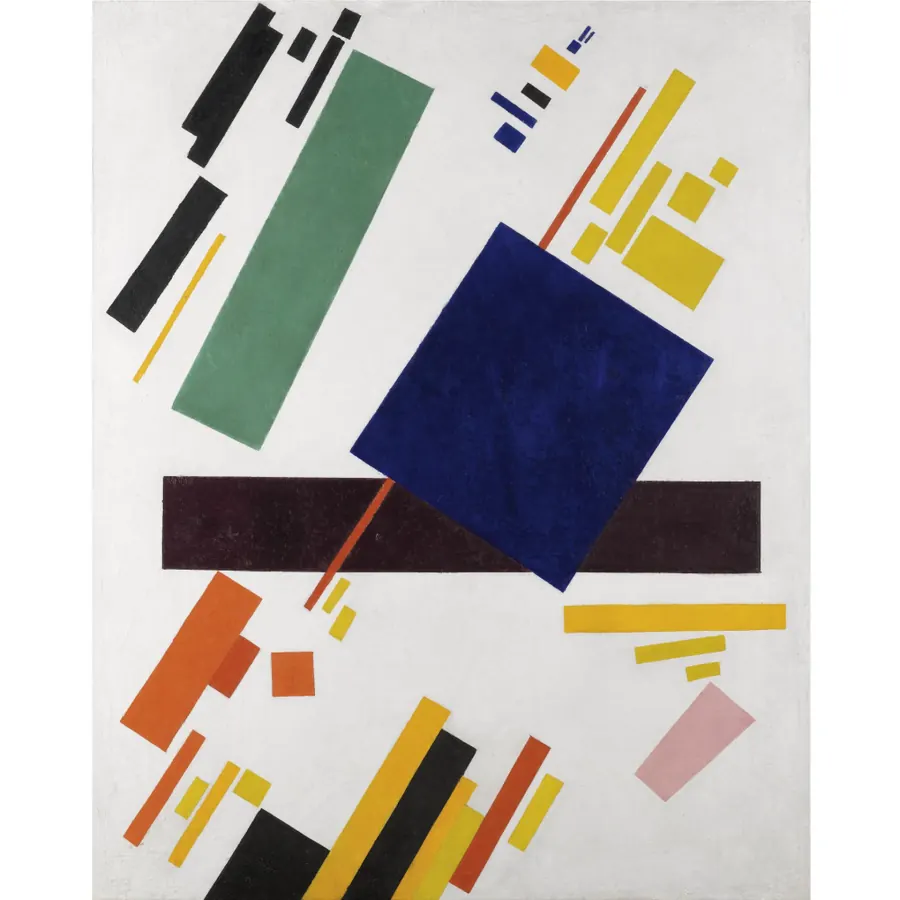
The scale of this is relatively recent. The first marked irrevocable bid appeared in a Sotheby's catalogue in November 2008, on a 1916 Kasimir Malevich painting. The timing was not accidental. Both major houses had been bruised that year by guarantees written on their own books - Sotheby's alone disclosed a $15m loss on autumn 2008 guarantees, and the two houses between them were reported to be holding around $63m of unsold guaranteed material going into the financial crisis.
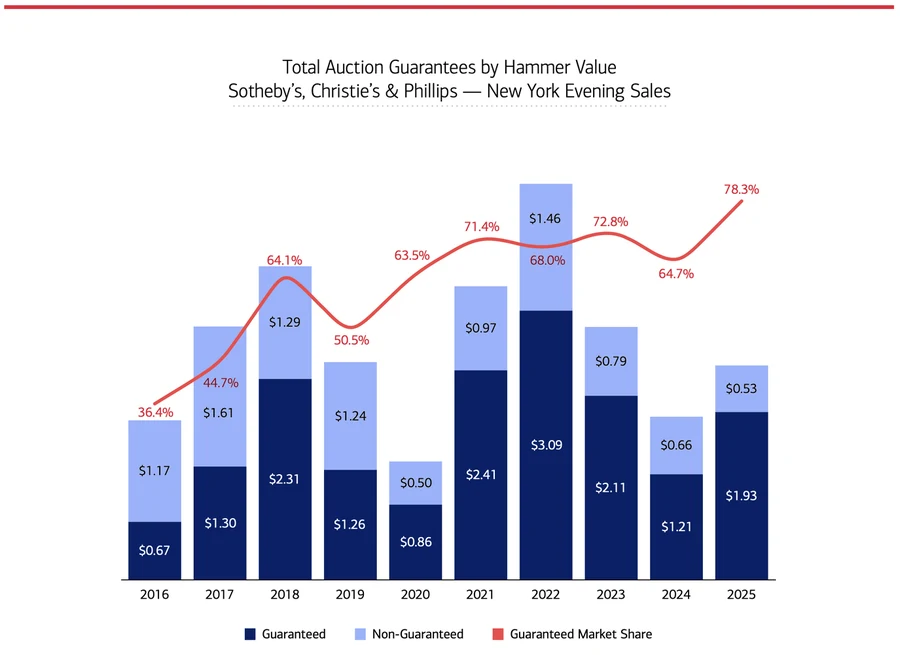
As the market recovered, the third-party model became the dominant mechanism for de-risking marquee consignments, and the shift in the underlying market has been substantial. In 2016, guarantees backed around 36% of the value of New York evening sales. By 2025, according to Bank of America and ArtTactic's 2026 U.S. Art Market Report, that figure had risen to 78% - the highest on record. Guarantees are no longer a feature of the marquee evening sale. They are increasingly built into its architecture.
It is worth noting that guarantees exist for good reasons. They allow auction houses to compete for great material, give consignors the confidence to bring works to market that might otherwise stay private, and have, on balance, expanded the universe of works available to bid on. The criticism, where there is one, is not of the instrument. It is of how the resulting sale is then described.
What has changed is not whether guarantees exist but how dominant they have become. A market in which 78% of an evening sale value is pre-arranged is a structurally different one from a market in which around a third was. It still produces extraordinary moments of genuine competitive bidding. But the assumption that a major evening sale will sell almost everything regardless of how the room feels has been quietly built in. A decade or two ago, a white-glove sale was a verdict the room delivered. It is now, increasingly, a condition the house engineers and the room either confirms or exceeds.
What the estimate is, and is not
The estimate band that accompanies a major lot is one of the more carefully arranged numbers in the auction process. It is not, despite the framing, an independent valuation. It is a negotiated figure, functioning partly as a market indication and partly as a piece of commercial positioning, agreed between the auction house and the consignor, intended to set expectations, attract bidding, and provide a public reference point for what may already have been arranged in private.
It is often believed that a conservative estimate draws more bidders into a sale and tends to produce stronger final prices than an ambitious estimate. A low estimate gives bidders permission to enter. An aggressive one quietly tells them not to bother. If it looks cheap in the room, serious bidders will push past the upper estimate because they sense other serious buyers in the field. If it looks expensive, those same bidders sit on their hands and wait to see whether anyone else takes the first risk. The Pauline Karpidas sale at Sotheby's last year (100% sold against an $80m total estimate, finishing at $136m) is a clean illustration of this dynamic. The number on the page is doing something other than predicting a price. It is shaping the behaviour of the people who will determine it.
In a guarantee-driven market, the estimate also has another, less visible function. If a lot has been guaranteed at $65m and the published estimate is $70–100m, the estimate is, in practice, a marketing range as the lower estimate sits above the privately agreed floor, the upper bound suggests upside but the floor itself was decided weeks, or even months, earlier. The published figure tells the public what the house and consignor hope the market will pay. What the public is not told is what has already been agreed. The estimate has become, in many cases, less a forecast than a frame.
The May 2026 spectrum
Read against this framework, the May 2026 sales present a clean range of cases. The Mnuchin Rothko carried a $70-100m estimate with no publicly-marked third-party irrevocable bid in the catalogue. It opened at $65m, drew competitive bidding between two parties, and landed at $74m hammer ($85.8m with fees), cleanly inside its estimates. While the Mnuchin sale was reportedly backed by guarantees in some form across all eleven lots, the bidding above the opening on the Rothko was genuine, and the result reads as market engagement rather than a single buyer transacting at a pre-agreed floor.
The Newhouse sale, by contrast, was (by Christie's catalogue markings) entirely backed by third-party guarantees. Every single one of the sixteen lots had been ‘pre-sold’ before the gavel fell. The 100% sell-through figure was, in that sense, determined in advance.
That is not a flaw. Two of the guaranteed Newhouse lots produced real competitive bidding well above their guarantee levels and set new artist records. A guarantee establishes a floor; it does not impose a ceiling, and the market chose to bid Pollock's Number 7A to nearly three times the previous record for the artist. The signal is real. But it is a different signal from the one Mnuchin produced. One sale asked the room a question. The other ensured the answer was in hand before the question was put.
This matters because it changes what the result tells you about the broader market. A white-glove sale of fully-guaranteed material confirms one specific thing: that a small group of major collectors, dealers and institutions (a pool believed to comprise fewer than thirty serious buyers at the upper end globally) were willing to commit to particular works at particular prices in advance. That is a meaningful signal. It is not the same signal as a room of independent bidders competing for material they had not seen pre-arranged.
The Phillips Modern and Contemporary Evening Sale on 19 May was, on its own terms, a white-glove result. All of the forty-one lots offered sold, for $115.2m (inc. fees), more than double the equivalent sale last year. About half of those lots had third-party guarantees. The achievement reflected, in significant measure, the auction house's willingness to revise estimates downward at the last minute (a Jean Dubuffet work on paper) and to withdraw the two lots that risked breaking the streak. The white-glove was real but the route towards it was managed.
What happens without a safety net
The other side of the picture is just as instructive. In May last year at Sotheby’s, the cover lot of the Modern Evening Sale was a 1955 Alberto Giacometti bronze titled Grande tête mince, consigned from the Soloviev Foundation with an estimate of around $70m and unusually for a work of that level, no guarantee. Bidding opened at $59m, reached $64.25m (on what some observers suspected were partly chandelier bids), and then stalled. The work passed and a $70m Giacometti walked away unsold.
What the Giacometti made visible is what a guarantee normally conceals. Without a pre-committed bidder, a major work depends entirely on whether the room is ready to engage at the seller's reserve. In May 2025, for that particular bust, it was not.
The estimate, by most accounts, was the original problem. At around $70m, it sat well above any recent precedent for a Giacometti bust, and well above the comfort range for buyers in a market that had been contracting for nearly two years. The consignor's approach compounded the difficulty. The late Sheldon Solow, whose foundation owned the work, had long preferred to refuse guarantees in exchange for a higher share of the buyer's premium. A strategy that worked well in the rising market of the late 2010s, but which offered no protection once the room turned cautious. By the spring of 2025, conditions at this level had shifted noticeably: global art sales had declined from 2022 highs, interest rates remained elevated, and recent legal disputes involving other significant Giacometti’s had added a layer of caution around the artist's top end. Sotheby's was reported to have attempted to lower the reserve in the days before the sale but was unable to reach an agreement with the consignor. The bust was, in effect, asked to bridge a gap the rest of the market was no longer willing to bridge.

When the guarantee itself fails
The mechanism is also not foolproof. In November 2024 at Phillips, a Jackson Pollock Untitled (around 1948) was offered with a low estimate of $13m, backed by a third-party guarantee from the film producer David Mimran at $14.5m. The work received no genuine bidding in the room. Under the terms of the guarantee, Mimran was contractually obliged to acquire it. He didn't pay. Phillips, having already committed to settle with the consignor (who, it later emerged, was Robert Mnuchin) was left to pursue Mimran in the New York Supreme Court for the full sum plus interest.
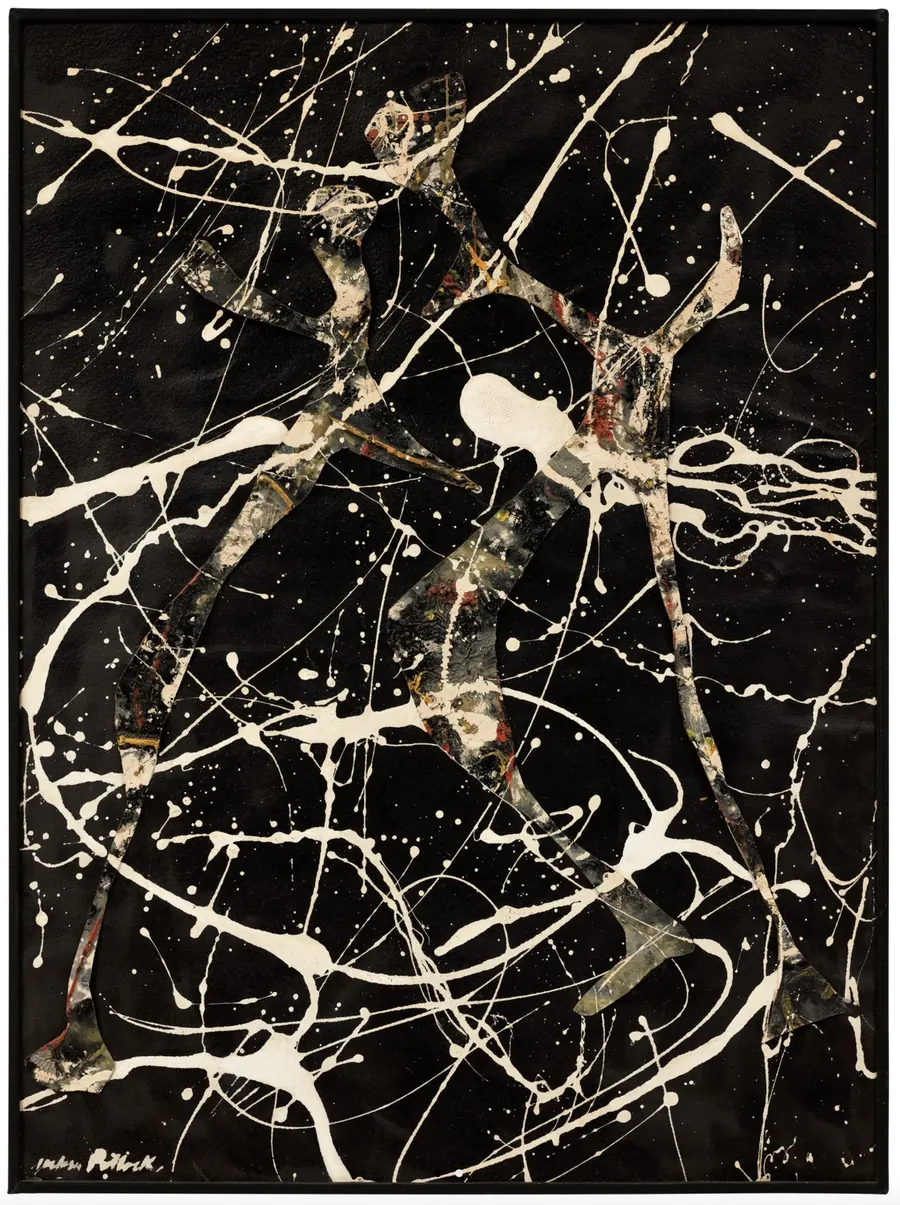
The same Pollock returned to Phillips's May 2026 evening sale with a revised estimate of $7–10m, and sold to a phone bidder for $7.4m hammer ($9.1m with fees). The same house that had been left exposed by the failed guarantee then resold the work cleanly. It is a useful case study in what guarantees can hide, what they can reveal, and what they can occasionally fail to deliver.
The Mimran case is also a useful reminder that the third-party guarantee market rests on a relatively small pool of well-capitalised participants. When one of them fails to perform, the consequences are not contained. Houses become more selective about whom they will work with on future deals, consignors become more attentive to who is actually backing their sale, and the apparent solidity of the guarantee mechanism reveals itself as resting on a smaller foundation than the catalogue would suggest. The instrument is robust in normal conditions. It is not invulnerable.
How to read a white-glove result
None of this argues against white-glove sales, or against guarantees. Both have their place, and both can produce results that genuinely reflect the market. But the term no longer carries a single meaning, and the press release rarely makes the distinction.
In our view, the figure is most usefully read alongside four further pieces of information: how many lots came under the hammer, and how many were withdrawn before or during the sale; how many of the offered lots were guaranteed; whether the result landed inside, above or below the estimate band; and whether the headline lots attracted competitive bidding from more than one party. A white-glove sale that satisfies all four is a strong signal of market depth. A white-glove sale that satisfies only the first is closer to a well-organised transaction.
Both have a place in a functioning market. The catalogue, if read carefully, will tell you which is which.
Images are reproduced for criticism and review. If you hold the rights to one and would like it credited differently or removed, please contact enquiries@klpartners.uk.